

Jewish Numismatics
Coins and Medals in the History of the Jewish People and the Holy Land
A coin fits in the palm of a hand, yet it can open a window onto an entire age. Across just a few centimeters, language meets image, everyday life meets power, religious tradition meets political ambition. Coins outlive the empires that produced them and preserve messages once intended for thousands of people. In Jewish history in particular – a history marked by cultural continuity as well as foreign rule, exile, persecution, and renewal – they become direct witnesses to the past.
The term ‘Jewish numismatics’ does not refer to an unbroken sequence of coins issued exclusively by Jewish rulers or communities. It encompasses the early coinages of the southern Levant, coins of Jewish dynasties and revolts, Roman representations of Jewish history, and issues from Judaea and the Holy Land under Roman, Byzantine, Islamic, and Crusader rule. It also includes modern coins and medals that speak to Jewish individuals and communities, emancipation and civic participation, as well as exclusion, persecution, and the Shoah.
The roots of this history reach back to the fifth and fourth centuries BCE. Under Persian and early Hellenistic rule, local silver coinages emerged in Philistia, Samaria, and Yehud. Philistine and Samaritan coins are not Jewish issues in the strict sense, but they form part of the political, economic, and cultural setting from which the coinage of Judah also developed. Greek, Achaemenid, Egyptian, and local motifs were adopted, adapted, and combined. The small silver coins of Yehud, bearing legends such as YHD or YHWD, ultimately show how the province of Judah articulated its identity within an imperial order through its own script and visual language.
Under the Hasmoneans, who ruled Judaea from the mid-second century until 37 BCE, coinage became a visible expression of Jewish political authority. Hebrew and Greek inscriptions, priestly and royal titles, and motifs such as cornucopias, pomegranates, anchors, and stars reflect both political autonomy and participation in the Hellenistic world. Herod the Great, king from 37 to 4 BCE, and his successors continued minting under Roman supremacy. Their coins document the complex interplay of local tradition, dynastic ambition, and political dependence on Rome.
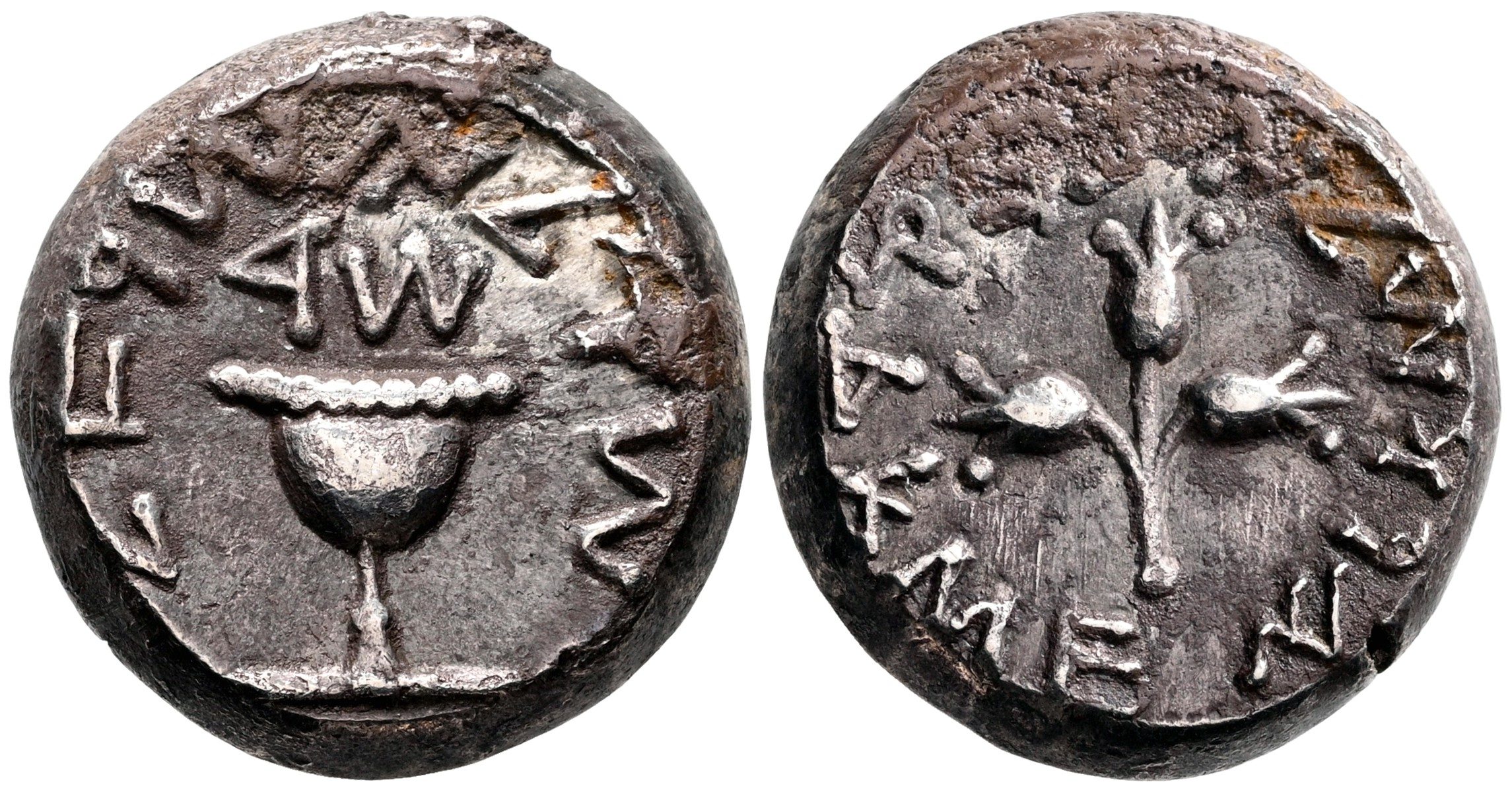
The language of coinage becomes especially powerful during the Jewish revolts. During the First Jewish Revolt of 66–70 CE, the rebels issued silver and bronze coins with Paleo-Hebrew inscriptions, religious symbols, and their own system of dating by the years of the revolt. Striking their own money was not merely an economic measure; it was a public assertion of freedom and sovereignty.
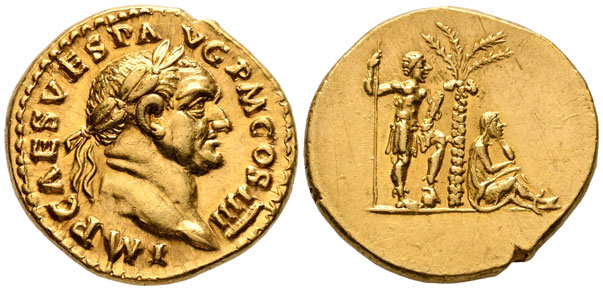
After the destruction of Jerusalem and the Second Temple, the Flavian emperors made victory over the revolt a central element of their dynastic self-presentation. Vespasian had emerged as emperor in 69 CE from a bloody civil war; the campaign in Judaea, begun under his command and brought to a conclusion by Titus, gave the new dynasty a shared military victory with which to legitimize its rule and present itself as the restorer of order and peace. On the so-called Judaea Capta issues, this message was distilled into images of the victorious emperor, military trophies, and a mourning personification of Judaea.
During the Bar Kokhba Revolt of 132–135/136 CE, the rebels overstruck large numbers of Roman coins already in circulation. Traces of the original designs often remained visible beneath the new motifs and inscriptions: the existing Roman monetary order was quite literally overwritten. Formulas such as ‘Freedom of Israel’ and ‘For the Freedom of Jerusalem’ appeared alongside depictions of the Temple, ritual objects, and the four species of Sukkot. The coins bear witness to political hope and religious memory, while also standing for a revolt that ended in defeat, persecution, and renewed displacement.
Beyond the coins of the revolts, the Roman provincial issues of the cities of Judaea, Samaria, and Galilee form an important field of collecting and research in their own right. Cities such as Aelia Capitolina, Caesarea Maritima, Neapolis, Gaza, Ascalon, Sebaste, and Tiberias issued bronze coins under Roman rule that combined imperial portraits with local sanctuaries, deities, foundation myths, and civic titles. They offer a direct view of the region’s political geography, religious diversity, and urban self-image in the centuries after the Jewish revolts.
With the transition to the early Byzantine period, imagery and religious references changed again. Coins associated with the Holy Land reflect its integration into the Eastern Roman Empire and its growing importance as a destination for Christian pilgrimage. After the Muslim conquest in the seventh century, Arab-Byzantine issues initially continued familiar Late Antique coin types; gradually, Arabic inscriptions and distinct Islamic coinages of the administrative district of Filastin took their place. In the twelfth and thirteenth centuries, coins of the Crusader states combined Latin Christian elements with regional and Islamic monetary traditions. These pieces, too, are not Jewish issues in the strict sense, but they form part of the numismatic history of the Holy Land and of the changing political orders under which Jewish communities lived.
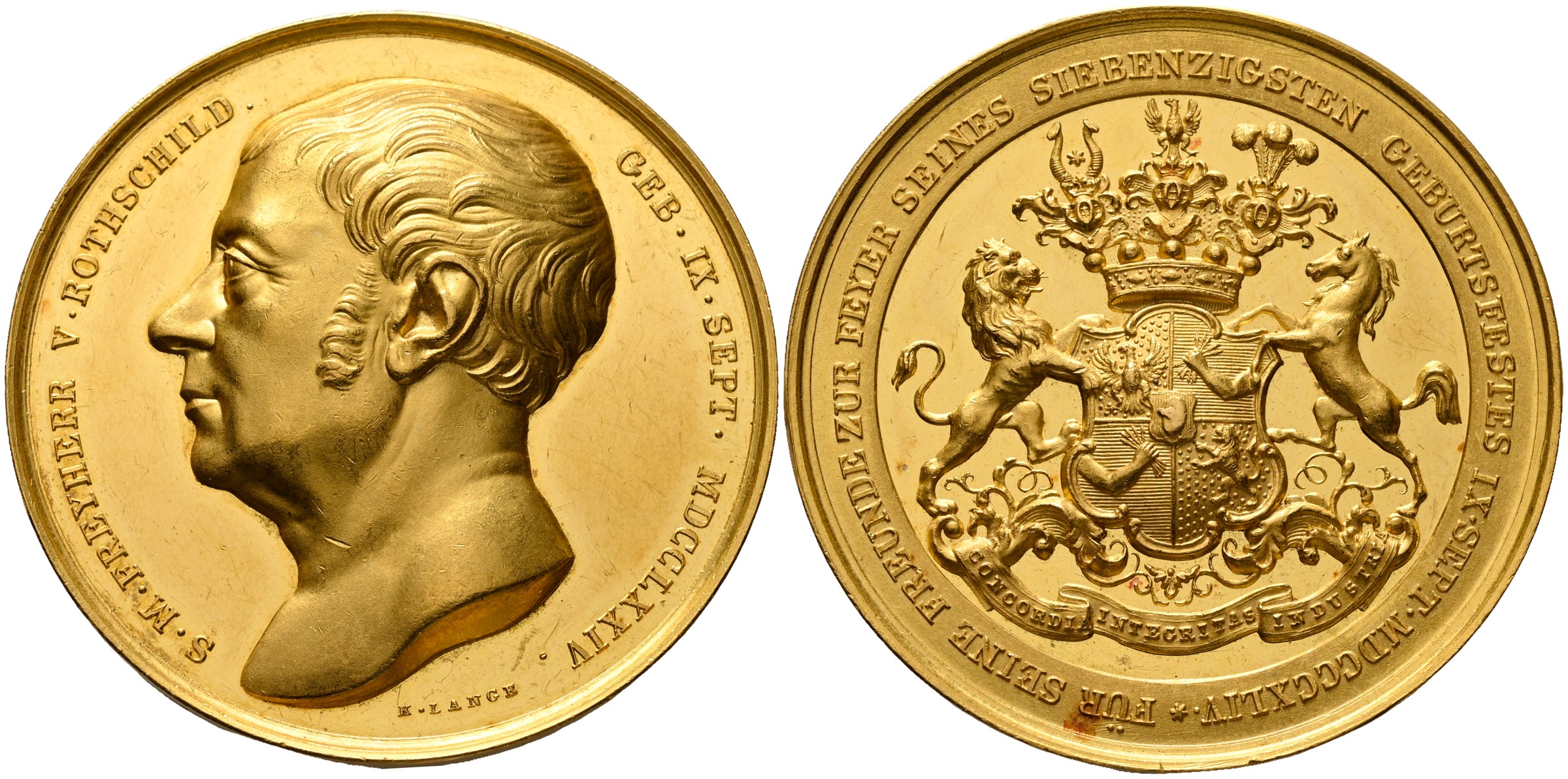
Jewish life continued throughout these centuries in numerous communities across the Diaspora. Numismatically, however, this history becomes especially tangible in the modern period, and increasingly so in the nineteenth and twentieth centuries. Medals commemorate scholars, prominent families, synagogues, communities, philanthropy, and the gradual legal emancipation of Jews in Europe. Some celebrate recognition and civic participation; others reveal anti-Jewish prejudice and the perspective of majority society. Numismatic objects can therefore preserve not only self-images, but also external perceptions, stereotypes, and mechanisms of exclusion.
Among the most harrowing objects are currencies and tokens from ghettos and camps established by the Nazis. So-called ghetto money, such as that from Łódź (‘Litzmannstadt’), was not an expression of Jewish autonomy. It was part of a system of isolation, control, forced labor, disenfranchisement, and exploitation. Such objects demand especially careful historical interpretation: their material nature must not obscure the fact that they bear witness to persecution, hunger, violence, and the Shoah. They belong within Jewish numismatics because Jewish history is concentrated in them as well – in its darkest chapter.
With the establishment of the State of Israel in 1948, the renewed use of ancient Jewish coin imagery took on new significance. Motifs and inscriptions from Yehud, the Hasmonean period, and the Jewish revolts were deliberately incorporated into the visual language of the modern state. The new coins thus created a visible link between ancient tradition, historical memory, and contemporary statehood.
Alongside the history of the objects, their scholarly study also developed. From the nineteenth century onward, Jewish coins were increasingly recorded systematically, classified typologically, and interpreted historically. Among the figures who have decisively shaped the field, and continue to do so today, are Adolf Reifenberg, Leo Kadman, Ya'akov Meshorer, Leo Mildenberg, Dan Barag, Shraga Qedar, Catharine C. Lorber, David Hendin, Haim Gitler, and Oren Tal. Their work represents different phases and methods of research – from foundational classification and historical interpretation to die studies, provenance research, archaeological contextualization, and critical reassessment of earlier attributions.
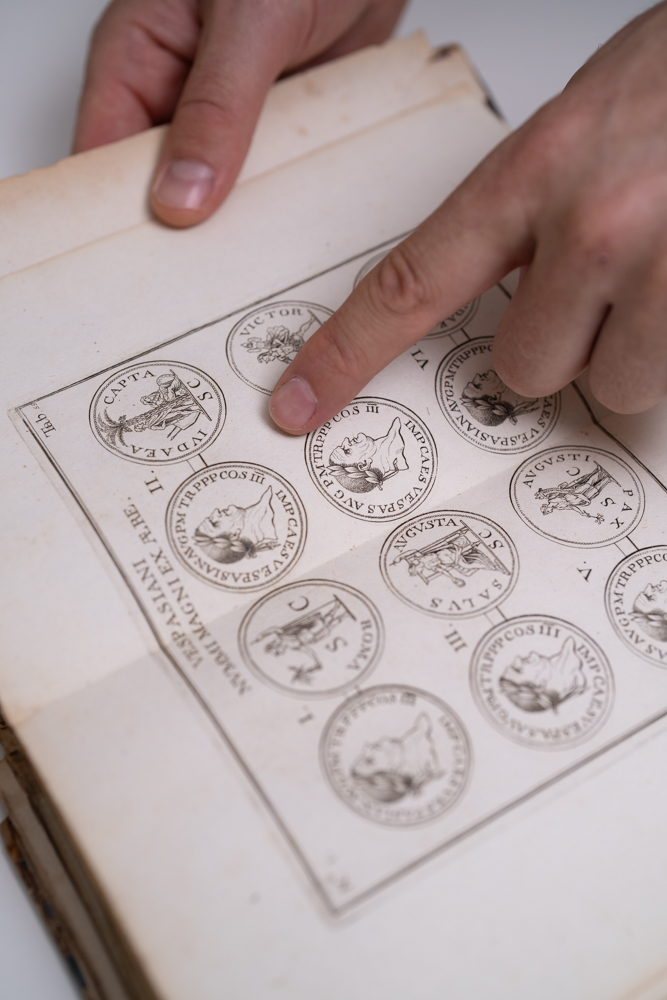
Today, the significance of a coin therefore lies not in rarity, material, or condition alone. Its meaning emerges from the analysis of inscription and image, weight, metal, and minting technique, as well as die links, documented provenance, and its place within literary, epigraphic, and archaeological sources. Depending on the object, different aspects come to the fore and deepen its historical interpretation. New finds and methods of analysis can alter established chronologies and call supposedly settled interpretations into question. Numismatic research remains a living process.
Jewish numismatics is not simply a history of money. It makes visible self-assertion and foreign rule, homeland and exile, cultural flourishing and violent rupture. When studied rigorously and documented responsibly, coins and medals become small, enduring archives of Jewish history.
The Leu Judaica Department builds on this scholarly tradition; the Leu Judaica Collection exemplifies the field’s broad historical and numismatic range.